


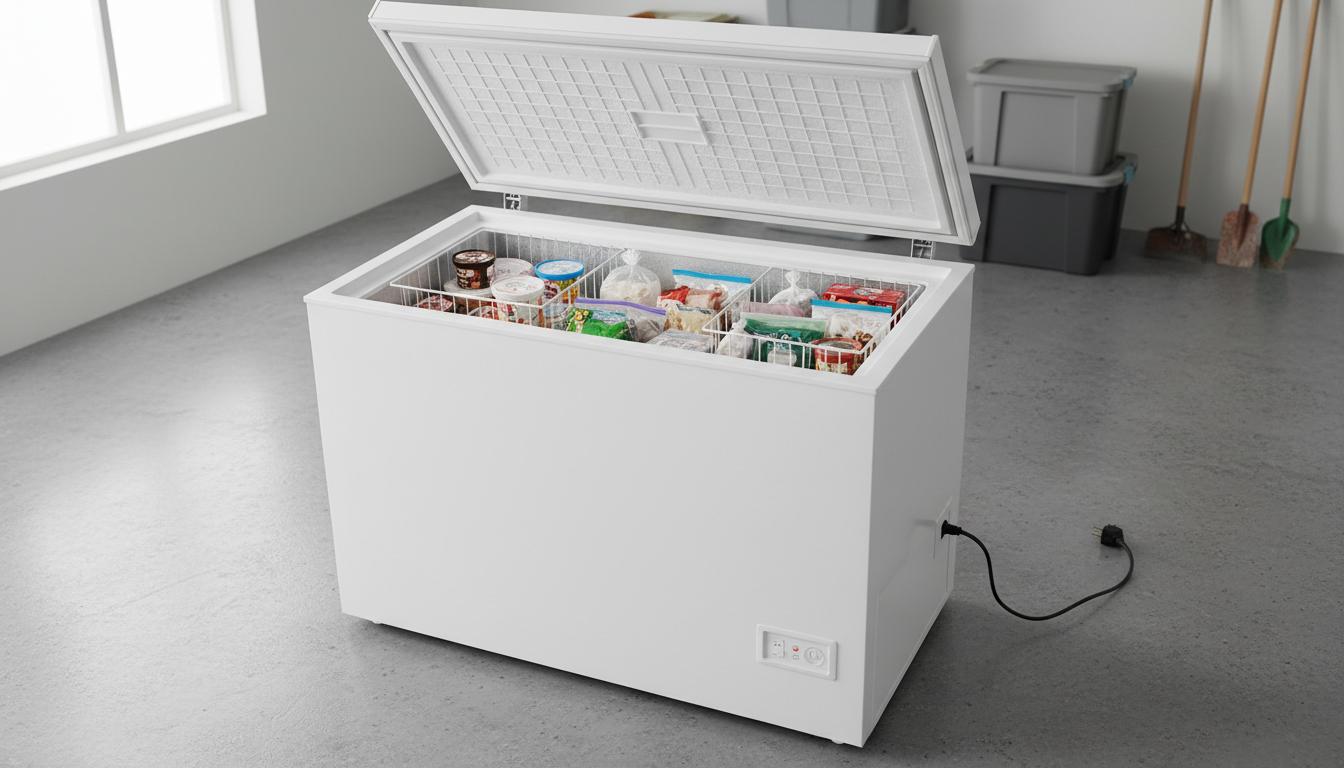
Chest freezer buying and care guide for New Zealand homes
A chest freezer is the quiet workhorse that turns bumper garden harvests, bulk meat deals, and fishing missions into year-round meals. If you’re in Aotearoa and considering one for the garage, shed, or laundry, this guide explains how a chest freezer works, the types available, what to look for, and how to use it well—without wasting power or food.
What is
A chest freezer is a top-opening standalone freezer designed for efficient long-term food storage. The wide, horizontal cabinet, thick insulation, and simple airflow make it more energy-efficient than many upright models. It’s popular in New Zealand for batch cooking, hunting, fishing, and reducing supermarket trips.
In practice, a chest freezer holds steady sub-zero temperatures (-18°C or below), keeps cold air inside when you open the lid, and can keep food safely frozen for longer during power cuts than most fridge-freezers.
How it works
At heart, a chest freezer uses a sealed refrigeration cycle:
- The compressor pushes refrigerant (commonly R600a/isobutane in modern units) through coils.
- Heat is released through external condenser coils, then the refrigerant expands and cools in evaporator coils inside the cabinet.
- That cold surface absorbs heat from the compartment. Insulation slows heat creeping back in.
Why this design saves energy:
- Cold air is dense. When you open a top lid, it doesn’t spill out as quickly as it does from an upright freezer.
- Chest freezers often have thicker insulation and fewer air paths, so they cycle less often.
- Most models use manual defrost. Without heater elements for frost-free cycles, they draw less power.
In New Zealand you’ll see the Energy Rating Label (the star label shared with Australia). It shows annual energy consumption (kWh/year) and a star rating to compare models at a glance.
Types / examples
Chest freezers vary by size, defrost method, and operating features. Here are the common types you’ll find across NZ retailers:
- Compact (80–150 L): Suits apartments, couples, or a bach. Fits a small garage corner.
- Mid-size (200–300 L): Good all-rounder for families. Often includes sliding baskets and an interior light.
- Large (350–500 L+): For hunters, gardeners, and bulk buyers. Requires more floor space and stronger organisation.
- Manual defrost: Most chest freezers. Best for energy savings and steady temperatures. Needs periodic defrosting.
- Frost-free (rarer in chest models): Convenience of no manual defrost, but slightly higher energy use and sometimes more dehydration (“freezer burn”) if food isn’t well wrapped.
- “Garage-ready” or wide climate class: Designed to operate correctly in cooler or hotter spaces. Check the climate class on the nameplate: SN (10–32°C), N (16–32°C), ST (16–38°C), T (16–43°C).
Chest freezer vs upright freezer (quick comparison)
| Feature | Chest freezer | Upright freezer |
|---|---|---|
| Energy efficiency | Generally lower kWh/year; better cold retention | Often higher kWh/year; cold spills when door opens |
| Access | Top-opening; can be deep to reach items | Front-opening shelves; easier item visibility |
| Defrost | Usually manual; fewer temperature swings | Often frost-free; convenient but uses more power |
| Floor space | Larger footprint; low height | Smaller footprint; taller height |
| Power cuts | Holds safe temps longer when unopened | Loses cold faster when opened |
| Noise | Usually very quiet | Varies; fan noise in frost-free models |
Pros and cons
Advantages
- Energy savings and stable cold storage for long periods.
- Great value per litre of storage.
- Better performance in outages—keeps food frozen longer if you keep the lid shut.
- Simple design with fewer parts to fail.
Limitations
- Takes up floor space; requires bending and reaching.
- Manual defrost for most models.
- Organisation matters, or items get buried at the bottom.
- Some models are not rated for very cold garages—always check climate class.
How to use or choose
Choosing the right chest freezer in New Zealand
Use these pointers to find a model that fits your home, usage, and power bill:
- Capacity guide:
- 1–2 people: 100–150 L
- 3–4 people: 200–300 L
- Large households, hunters, gardeners: 350 L+
- Energy Rating Label: Compare kWh/year and star ratings. Lower kWh/year at the size you need usually wins.
- Climate class: For unheated garages or sheds, look for SN or wider (SN/ST/T) to ensure reliable operation across seasons.
- Footprint and access: Measure doors, hallways, and final location. Allow ventilation space per the manual (often 10 cm sides/back).
- Refrigerant: R600a (isobutane) is common and efficient with a low global warming potential.
- Controls and features: External thermostat, interior light, counterbalanced lid, lock, removable baskets, drain for defrost water.
- Noise and vibration: Helpful if placing near bedrooms or a home office.
- Warranty and service: Check local support and parts availability. Consumer NZ reviews are a useful cross-check.
Where to place it
- Solid, level floor. Keep it dry and out of direct sun.
- Leave airflow gaps as specified by the manufacturer.
- Plug directly into a 230–240 V 50 Hz wall outlet. Avoid extension leads. Use an RCD-protected circuit in garages and sheds.
- Keep away from heat sources (ovens, hot water cylinders) to reduce energy use.
Set-up and first run (step-by-step)
- Unpack and check for transit damage. Remove all tape and foam.
- Position and level with a spirit level. Leave the recommended clearance.
- If the unit was on its side, wait the manufacturer’s stated time (often 4–12 hours) before powering on to let oil settle.
- Plug in and set the thermostat to -18°C.
- Let it run empty until the temperature is stable (usually overnight).
- Load pre-frozen items first. Spread new unfrozen food in smaller batches so you don’t overwhelm the system.
Smart organisation to prevent waste
- Use baskets and stackable bins to create “zones” (meat, seafood, veg, bread, leftovers).
- Label and date everything. First-in, first-out rotation reduces freezer burn.
- Flat-freeze in zip bags on a tray, then file upright like books—fast to find, fast to defrost.
- Keep a simple inventory on the lid or your phone. Update it after each shop.
Defrosting and cleaning
Manual defrosting every few months keeps efficiency high. A 5–10 mm ice build-up is your cue.
- Move food to a chilly bin with ice packs or a neighbour’s freezer. Work on a cool day if possible.
- Switch off and unplug. Open the lid.
- Place towels and a tray at the drain. Use the drain spout if fitted.
- Speed the process with bowls of hot (not boiling) water inside. Never chip ice with knives or sharp tools.
- Wipe the interior with warm water and a little baking soda. Rinse and dry thoroughly.
- Restart, cool to -18°C, then reload. Use any items that softened first.
Food safety basics for NZ households
- Freezer temperature: Keep at -18°C or below. Use a freezer thermometer to verify.
- Power cut rule: Keep the lid shut. A full chest freezer can keep food safely frozen for roughly 24–48 hours if unopened.
- Refreezing: If food still has ice crystals and is at 5°C or colder, it can usually be refrozen; quality may drop. If it has thawed and warmed above 5°C, cook promptly or discard.
- Thawing: Best in the fridge. For speed, use cold water in a sealed bag or the microwave, then cook immediately.
Running costs and efficiency tips
- Buy the right size. Oversized units cost more to run, even when half empty.
- Keep it reasonably full. Use water bottles or ice packs to stabilise temps if needed.
- Open the lid briefly and infrequently. Plan what you need before opening.
- Vacuum condenser coils annually if accessible. Good airflow lowers energy use.
- Check the gasket seal with a paper test. Replace if loose or cracked.
End of life and recycling in New Zealand
- Contact your local council or a licensed recycler to handle refrigerant recovery safely.
- Some retailers offer take-back when you buy a new chest freezer.
- Remove the lid or secure it before roadside collection for safety.
FAQ
What size chest freezer do I need?
As a rule of thumb: 100–150 L for one or two people, 200–300 L for a family, and 350 L+ for bulk storage, fishing, or hunting. Match capacity to your buying and cooking habits.
Is a chest freezer worth it for a Kiwi household?
Yes if you bulk-buy meat, grow produce, batch-cook, or live far from shops. Lower running costs and better cold retention make a chest freezer cost-effective over time.
Can I put a chest freezer in the garage?
Often, yes. Check the climate class rating on the nameplate (SN/N/ST/T). Many garages in NZ get cool in winter; choose a model rated for 10–32°C (SN) or wider. Keep it off damp floors and out of direct sun.
Manual defrost or frost-free—what’s better?
Manual defrost chest freezers are more energy-efficient and gentler on food moisture. Frost-free is convenient but can cost more to run and may dry food faster without good packaging.
How cold should a chest freezer be?
Set it to -18°C. This balances food safety, quality, and efficiency. Colder settings use more power without much benefit for most foods.
How long will food stay frozen in a power cut?
If full and unopened, roughly 24–48 hours is typical. Keep the lid shut. After power returns, check that food is still hard-frozen or at least shows ice crystals before refreezing.
What’s the best way to organise a chest freezer?
Use baskets and bins by category, label everything with dates, keep frequently used items on top, and rotate stock. An inventory list on the lid helps stop doubles and waste.
Is a chest freezer noisy?
Most run quietly with occasional compressor hum. Noise levels vary; check specifications and reviews if it’s near living spaces.
Can I run a chest freezer on solar or a generator?
Yes, if your system handles the starting surge and continuous load. Use a suitable inverter for solar, and a clean, stable output for generators. Avoid extension leads; use a dedicated outlet with RCD protection.
How do I dispose of an old chest freezer in NZ?
Book collection with your local council or an e-waste recycler. Refrigerant must be recovered by a licensed technician. Some retailers offer removal when delivering a new unit.
Final tip
Choose a chest freezer with the right capacity and climate rating, keep it organised, and maintain it with simple defrosting. Do that, and you’ll spend less, waste less, and always have dinner ready to go.